
Several beaches in Malaga have been temporarily closed after E. coli was detected during routine water quality tests. Here’s what tourists need to know.
Update – October 1, 2026: Following recent heavy rainfall, Málaga City Council has advised against swimming temporarily at four city beaches — Campo de Golf, Sacaba, La Misericordia and San Andrés — after E. coli was detected in the water. Further water quality tests are being carried out to determine when swimming can safely resume.
UPDATE – August 20, 2026: Málaga and Benalmadena beaches reopened.
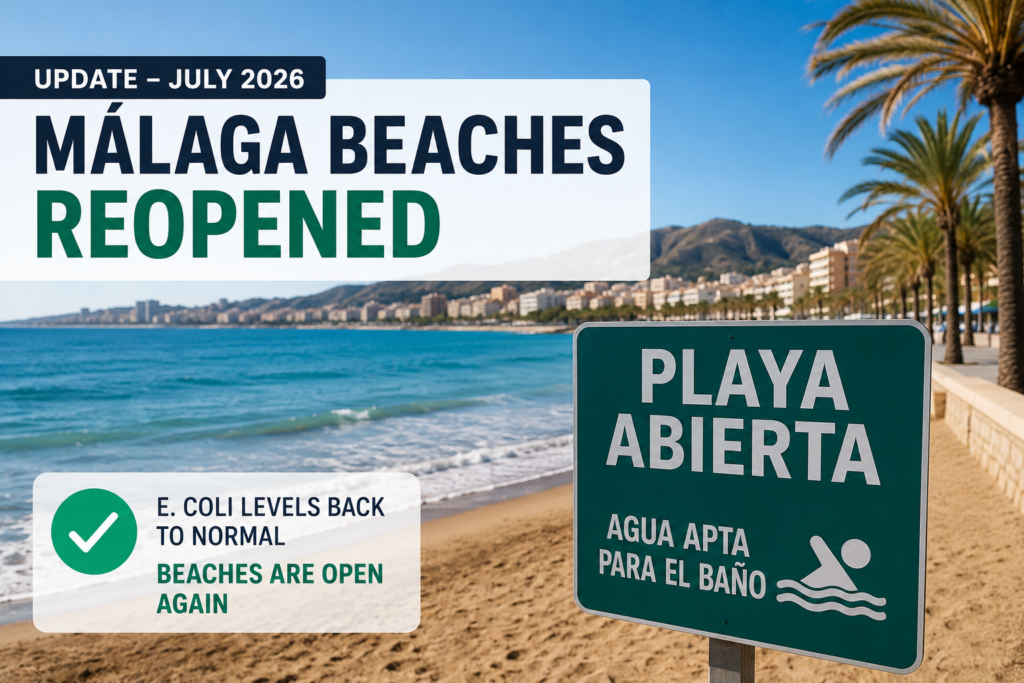
Update – 25 July 2026: Málaga beaches have reopened
The temporary swimming bans introduced on some Málaga beaches have now been lifted after follow-up water quality tests confirmed that E. coli levels had returned to normal. Beaches such as Pedregalejo and El Palo are once again open for swimming.
The closures lasted only around 24 hours and were implemented purely as a precaution, following routine water quality monitoring carried out by the Andalusian health authorities. Once laboratory analyses confirmed that the water met legal bathing standards, the restrictions were removed.
While the exact cause of the temporary increase in bacteria is still being investigated, local authorities have ruled out sewage leaks from Málaga’s municipal water network. Experts believe a combination of very high numbers of bathers, warm weather and limited water circulation may have contributed to the isolated readings.
This incident also highlights something positive for visitors: Spain carries out regular and transparent water quality monitoring on its beaches. Temporary closures like this are uncommon, but they demonstrate that authorities act quickly whenever there is even a small potential health risk, reopening beaches as soon as independent laboratory tests confirm the water is safe again.
Malaga beaches closed due to E. coli: What tourists need to know
If you’re spending your holiday on the Costa del Sol, you may have seen headlines about temporary beach closures in Málaga following the detection of Escherichia coli (E. coli) in routine seawater tests.
At first glance, this may sound alarming.
The reality is much less dramatic.
These closures are precautionary, affect only specific sections of the coastline and, perhaps most importantly, demonstrate that Spain’s beach monitoring system is working exactly as it should. Authorities detected the issue through routine water quality testing before it became a wider public health problem.
If you’re planning to visit Málaga this week, here’s everything you need to know.
Which beaches are currently closed?
At the time of writing, swimming has been temporarily prohibited at parts of the eastern coastline of Málaga city, including:
- Pedregalejo Beach
- El Palo Beach
- Baños del Carmen Beach
Red flags have been raised and bathers are asked not to enter the water until new laboratory analyses confirm that the water meets health standards again.
Important: If Marbella or any other municipality later announces additional precautionary closures, they are separate incidents managed independently by each local authority. Always check the latest official information before visiting a specific beach.
Why were these beaches closed?
The beaches were closed after routine monitoring detected higher-than-permitted concentrations of Escherichia coli (E. coli) in water samples collected by the Andalusian health authorities.
E. coli is one of the microbiological indicators used throughout Europe to assess bathing water quality. Elevated levels suggest that the water may have been contaminated and that swimming should be temporarily avoided until further testing confirms it is safe again.
Authorities emphasise that this is a precautionary public health measure, not evidence of a widespread environmental emergency.
Is it safe to swim elsewhere in Málaga?
Yes.
Only the affected beaches have been closed.
The vast majority of Málaga’s coastline remains open, and visitors can continue enjoying beaches that are not subject to any restrictions.
As always, simply follow the instructions displayed on the beach and respect the flag system used by lifeguards.
What is E. coli?
Escherichia coli is a bacterium naturally present in the intestines of humans and animals.
Most strains are harmless. However, when unusually high levels are detected in bathing water, they indicate that contamination may have occurred.
Swimming in contaminated water can increase the risk of:
- Stomach upset
- Diarrhoea
- Ear infections
- Skin irritation
For this reason, authorities temporarily suspend bathing until laboratory analyses confirm that water quality has returned to normal.
What caused the contamination?
At this stage, the exact cause is still under investigation.
According to local authorities, there is currently no evidence that the contamination was caused by sewage discharges from Málaga’s public water network or by the ongoing promenade works in Pedregalejo, despite speculation on social media.
Investigations are continuing while additional water samples are analysed.
When will the beaches reopen?
There is no confirmed reopening date yet.
Health authorities are carrying out additional analyses, and the beaches will reopen as soon as bacterial levels return below the legal thresholds established for bathing waters.
These precautionary closures often last only a short period, depending on laboratory results and weather conditions.
Why this is actually reassuring
Although temporary beach closures generate worrying headlines, they are also evidence that Spain’s water quality monitoring system is doing exactly what it is designed to do.
Throughout the bathing season, beaches across Andalucía are subject to regular microbiological testing. Water samples are routinely analysed for bacteria such as E. coli and intestinal enterococci to ensure that bathing waters comply with strict European health standards.
When a sample exceeds the permitted limits, authorities do not wait for people to become ill.
Instead, they immediately:
- Raise the red flag.
- Prohibit swimming.
- Carry out additional testing.
- Reopen the beach only when laboratory results confirm that the water is safe again.
This transparent approach protects both residents and millions of tourists who visit the Costa del Sol every year.
In other words, the reason you are hearing about these closures is because the monitoring system detected the problem early.
That should inspire confidence rather than concern.
Are beach closures like this unusual?
Not at all.
Temporary bathing restrictions occur from time to time in coastal destinations across Europe whenever routine testing identifies bacterial levels above legal limits.
Similar precautionary closures have taken place in countries including Spain, France, Italy, Portugal and the United Kingdom.
In nearly all cases, beaches reopen shortly after follow-up tests confirm that the water quality has returned to normal.
Should tourists cancel their holiday?
Absolutely not.
Málaga province has dozens of beaches stretching along the Costa del Sol.
Only a very small number are currently affected by precautionary swimming restrictions.
Hotels, restaurants, beach bars, museums, attractions and almost every other beach continue operating as normal.
For most visitors, this situation simply means choosing another nearby beach for a day or two.
Our advice
If you’re visiting Málaga this week:
- Respect the red flags.
- Do not swim in beaches where bathing has been temporarily prohibited.
- Choose one of the many nearby beaches that remain open.
- Follow official information rather than rumours on social media.
- Remember that these measures exist to protect public health.
Current status – 05/08/2026
All temporary swimming restrictions affecting Málaga city beaches have now been lifted following new laboratory tests confirming that water quality complies with Spanish and European bathing standards. Visitors can continue to check the latest beach conditions through the official beach information services, but at the time of this update the affected beaches are open again.
Frequently Asked Questions
Are all Málaga beaches closed?
No. Only specific beaches on the eastern side of Málaga city are currently affected.
Is Málaga safe to visit?
Yes.
The city remains completely safe for tourists, and the temporary restrictions apply only to swimming at the affected beaches.
Can I still visit Pedregalejo?
Yes.
The promenade, restaurants, cafés and beach bars remain open.
Only entering the water is temporarily prohibited.
Is it safe to eat seafood?
Yes.
These precautionary bathing restrictions are unrelated to seafood served in restaurants.
How long do E. coli beach closures usually last?
It depends on follow-up water quality results, but many precautionary closures last only a few days before swimming is allowed again.
Final thoughts
While headlines mentioning “faecal bacteria” naturally attract attention, it’s worth remembering the bigger picture.
The temporary closure of a handful of beaches does not mean Málaga has a widespread pollution problem.
Instead, it shows that regular water quality controls are working exactly as intended: identifying potential risks early, informing the public transparently and ensuring that beaches only reopen once they are confirmed to be safe.
For visitors to the Costa del Sol, that’s reassuring news.