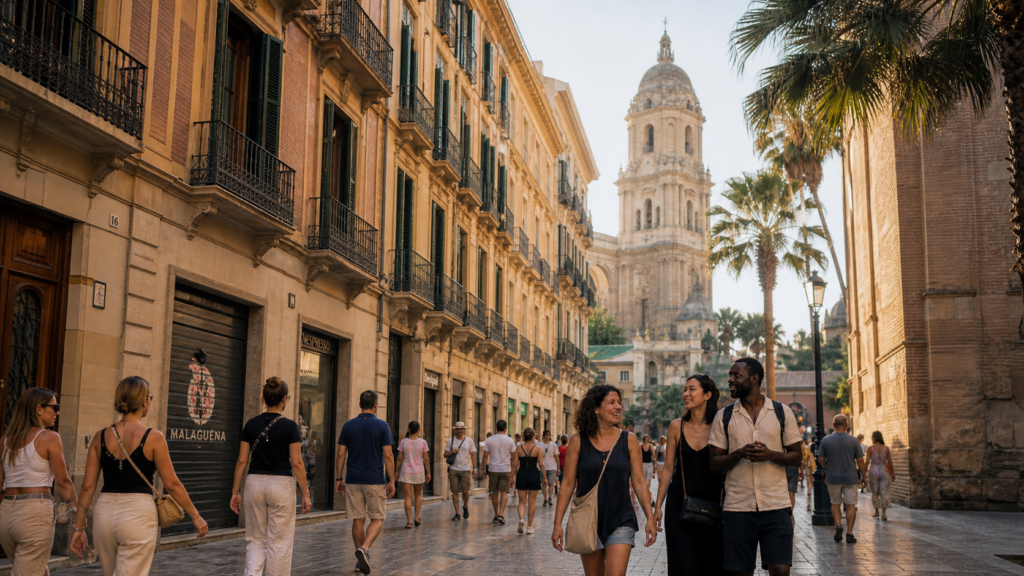
Málaga is one of the most international cities in southern Spain. If you arrive from abroad, you notice it quickly: different languages on the street, different food traditions, different rhythms of life, all sharing the same light, the same sidewalks, the same winter sun. But beneath that first impression lies a more human question — one that many newcomers ask quietly before they move: are foreigners really welcome in Málaga?
The short answer is: generally, yes. Málaga and much of the Costa del Sol are used to living with people from elsewhere. Foreign residents are not a side note here; they are part of the fabric of the city. In Málaga city, the registered foreign population reached 65,249 people in 2024, around 11% of the total population, and that share has grown significantly over the past decade.
But this is not a postcard answer. Being welcomed is not the same as fully belonging. Like everywhere else, real life in Málaga is shaped by housing prices, tourism pressure, work opportunities, language barriers, class differences and the slow work of building a place in a neighborhood. This article looks at that reality through a mix of travel writing and grounded reporting: who the foreign communities in Málaga are, where they live, how convivencia works in practice, and why the Feria Internacional de los Países in Fuengirola — often informally called the Feria de los Pueblos — says so much about the multicultural Costa del Sol.
Málaga, a city that now speaks in many accents
Some cities reveal themselves quickly. Others take time. Málaga belongs to the second kind.
At first glance, it offers everything the travel imagination expects: sea, terraces, soft winters, long evenings, and that almost suspicious ease with which a short stay can become a longer one. But if you stay attentive, another truth emerges: Málaga is no longer only a southern Spanish city with a tourism economy; it is also a city of arrivals, blended identities and shared accents.
That matters because it changes the question. This is no longer just about whether Málaga is pleasant to visit. It is about whether it is possible to live here as a foreigner and feel that life is not constantly being lived from the outside.
The official numbers suggest a city that is already deeply international. In 2024, foreign residents represented 11% of Málaga city’s registered population, a figure that reflects not just tourism, but settlement. Neighbors, not only visitors.
Are foreigners welcome in Málaga?
This is the question at the heart of the article, and it deserves a careful answer.
In broad terms, yes: foreigners are generally welcome in Málaga. The city and the wider Costa del Sol are highly accustomed to living with people from different countries, and the institutional language around migration and diversity is framed in terms of inclusion, equal rights, social cohesion and convivencia. The Andalusian Strategy for Immigration 2021–2025 is built around precisely those ideas. Fuengirola, meanwhile, openly presents itself as “a welcoming city where citizens from all over the world live together.”
Still, it would be misleading to turn that into a glossy slogan. A city can be used to diversity without being free of tension. Everyday coexistence is also shaped by practical issues: rent, noise, overtourism, precarity, access to housing, and the ease — or difficulty — of building real neighborhood life. Andalusian public planning documents on tourism already stress the importance of balancing resident–visitor coexistence, while municipal documents in Málaga warn that weaker integration and coexistence between cultures can damage social cohesion.
So the most honest answer is this: Málaga often receives people well, but real belonging is built through reciprocity, not marketing. The city tends to respond well to those who try to understand its pace, respect its neighborhoods, and treat it as a place to live rather than a permanent backdrop.
What foreign communities live in Málaga?
There is no single “foreign community” in Málaga. There are many.
According to municipal data for 2024, the main broad origin groups within the foreign population of Málaga city were:
- South America: 30.3%
- Africa: 19.9%
- European Union: 18.6%
- Rest of Europe: 16.8%
That tells you something important straight away: today’s international Málaga does not fit one stereotype. It includes retirees from northern Europe, Maghrebi families, Latin American workers, students, small business owners, remote professionals, mixed-nationality couples, and people who arrived because of work, climate, love, crisis or simple fatigue with another kind of life.
The main foreign nationalities in Málaga
When you move from broad regions to specific communities, the picture becomes more vivid.
In detailed municipal tables available for 2022, the largest foreign nationalities in Málaga city included Ukrainian and Italian residents. Other highly visible communities across the city included people of Moroccan, Chinese, Paraguayan, Colombian, Argentine, Venezuelan, Romanian and Russian origin, alongside British, French, German and American residents in some districts.
And you do not need a chart to notice this. You see it in international supermarkets, in evangelical churches tucked into ordinary streets, in Ukrainian and Italian restaurants, in locutorios that have evolved into hybrid food-and-phone shops, in cafés where Russian and Colombian Spanish overlap, and in the many quiet, ordinary places where migration becomes routine rather than spectacle.
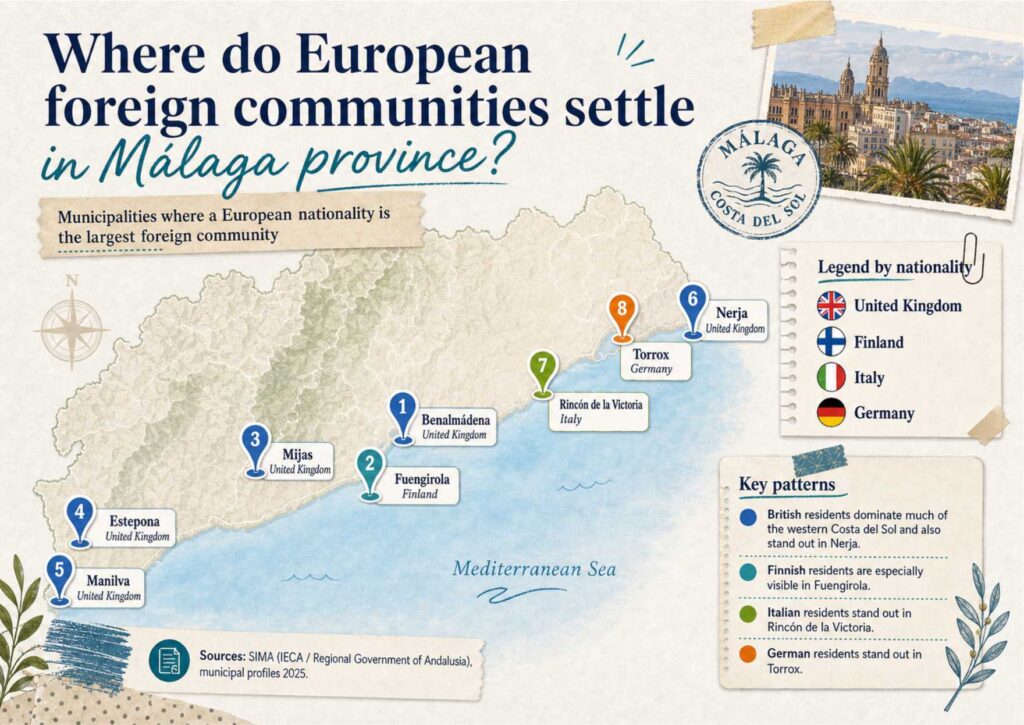
Where do more foreigners live in Málaga?
For anyone searching for housing or trying to understand the geography of the city, this is one of the most practical questions.
In 2024, the largest concentrations of foreign residents in Málaga city were found in:
- Centro
- Carretera de Cádiz
- Cruz de Humilladero
- Bailén-Miraflores
Together, these four districts accounted for 70.6% of all foreign residents registered in the city.
That does not mean the rest of Málaga lacks diversity. It means these areas are where international life becomes especially visible — in shops, schools, rental markets, public services, restaurants and daily street life.
In Carretera de Cádiz, for example, Ukrainian, Moroccan and Chinese communities were especially present. In Centroand Teatinos, the profile leaned more toward European and Latin American residents. Other districts also showed strong Paraguayan, Colombian and Venezuelan presence.
Living in Málaga as a foreigner: between welcome and real life
There is a difference between being received and feeling at home. The first can happen in a weekend. The second takes time.
Málaga helps that process in at least two ways:
- it has a public culture that is already used to social and cultural mixing,
- it still retains neighborhood life, even amid tourism growth, urban change and rising housing pressure.
Foreign residents are not marginal to the city’s daily reality. They are present in schools, healthcare, parks, coworking spaces, local bars, logistics, hospitality and small commerce. That normality matters. It means many newcomers do not feel immediately marked as exceptions.
But there is also something that should be said clearly: Málaga does not always look at every foreigner in exactly the same way. In real life, perception is shaped by class, language, work, neighborhood and purchasing power. A high-income newcomer may be framed as cosmopolitan investment; a lower-income migrant worker may be read very differently. That is not unique to Málaga — it is one of the contradictions of many Mediterranean cities under pressure from tourism, relocation and the housing market.
So perhaps the better question is not simply whether foreigners are welcome, but how to become part of life in Málaga well. And the answers are usually less dramatic than the question itself: learn some Spanish, move slowly, respect local routines, support neighborhood life, and avoid treating the city as a service platform.
Fuengirola and the multicultural Costa del Sol: the meaning of the Feria de los Pueblos
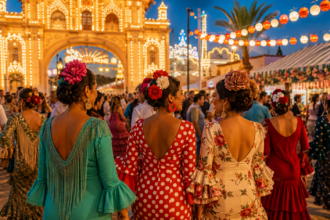
If there is one public event that captures the multicultural spirit of the Costa del Sol, it is the Feria Internacional de los Países in Fuengirola — often referred to informally by many locals and residents as the Feria de los Pueblos.
According to Fuengirola’s official tourism portal, the event began in 1994 and has become one of the most important multicultural festivals of its kind on the Costa del Sol. It is not simply a fairground display of national costumes and food. During those days, the city becomes a temporary map of the world, with countries and communities represented through music, dance, cuisine and social participation.
In 2024, the event brought together 33 participating countries and communities, according to the annual tourism department report. That number matters less than what it symbolizes: the Costa del Sol does not only live with diversity — it stages it publicly, proudly and festively. (
You can move from an Argentine stand to a Finnish one, hear Balkan music, eat Latin American food, finish with Arab or African rhythms, and leave with the sense that identity here is not a fixed wall but an expandable table.
Why the Feria Internacional de los Países matters to foreign residents
For many foreign residents on the Costa del Sol, this festival means more than entertainment.
It is:
- a place to feel visible,
- a space for cultural representation,
- a way to participate publicly without erasing one’s own origin,
- and a reminder that local identity can stretch without disappearing.
Of course, a fair does not solve structural issues like housing, wages or integration. But it does reveal something important: when convivencia works, it stops being a theory and becomes a habit.
That may be one of the clearest answers to the question of whether foreigners are welcome in Málaga and on the Costa del Sol. In the best cases, welcome is not a performance. It becomes routine.
Málaga as a travel notebook, not a moral lesson
Walking through Málaga with this question in mind — how do foreigners really live here? — changes what you notice.
You stop counting only churches, museums and sunsets. Other details begin to matter: how many languages fit into one market queue, how many nationalities share a school gate, how a city changes when people stop visiting it and start building a life inside it.
Málaga then appears less like a closed city and more like a conversation. An imperfect conversation, sometimes unequal, but very real.
Inside that conversation there is room for the Malagueña who gently corrects your Spanish at the bakery, the Argentine waiter who explains how to search for an apartment without losing half your income, the Moroccan family already fully woven into school life, the Italian professional who came for the weather and stayed for the texture of everyday life, the British retiree who discovers too late that the real luxury was not the sunshine but the neighborhood, and the Ukrainian woman who turned forced arrival into a new routine.
Part of that plurality is documented in municipal data. Another part can only be understood by walking.
So, can Málaga be a good place to live as a foreigner?
Yes — it can.
Not because everything is easy.
Not because tension does not exist.
Not because no one will ever remind you that you came from somewhere else.
But because Málaga already knows how to live with many origins at once. And because, at its best, the city does not ask you to stop being who you are. It asks you to arrive slowly, listen carefully, learn the rhythm, and sit down at the table.
FAQ: foreign communities in Málaga
Are there many foreigners living in Málaga?
Yes. In Málaga city, 65,249 foreign residents were registered in 2024, representing 11% of the municipal population.
Are foreigners welcome in Málaga?
Generally, yes. Málaga and the Costa del Sol are very used to living with foreign residents. Still, real experiences vary depending on housing, language, neighborhood, work, income and level of local integration.
What are the main foreign communities in Málaga?
Málaga has a wide mix of communities. Among the most visible or significant are people of Ukrainian, Italian, Moroccan, Chinese, Paraguayan, Colombian, Argentine, Venezuelan, Romanian, Russian, British, French, German and American origin.
Which areas of Málaga have more foreign residents?
The main districts with higher concentrations of foreign residents are Centro, Carretera de Cádiz, Cruz de Humilladero and Bailén-Miraflores. Together they account for 70.6% of Málaga city’s foreign population.
What is the Feria de los Pueblos in Fuengirola?
It is the popular name many people use for the Feria Internacional de los Países, a major multicultural festival in Fuengirola where countries and communities showcase food, music, dance and cultural traditions.
When is the Feria Internacional de los Países held?
It is held annually, although the exact dates vary each year. The best option is to check Fuengirola’s official tourism or municipal calendar.
Why is this festival important on the Costa del Sol?
Because it makes the multicultural identity of the Costa del Sol visible in public space. It is not only about entertainment; it is also about representation, convivencia and shared celebration.
Is Málaga a good city for expats, immigrants or digital nomads?
It can be, especially because of the climate, outdoor lifestyle and international environment. But the experience depends a lot on budget, housing, language skills and willingness to integrate into everyday local life.
What is the main challenge of living in Málaga as a foreigner?
More than social acceptance, one of the most frequently cited challenges today is housing affordability, especially in areas affected by tourism and relocation pressure. Language, bureaucracy and building a support network also matter.